
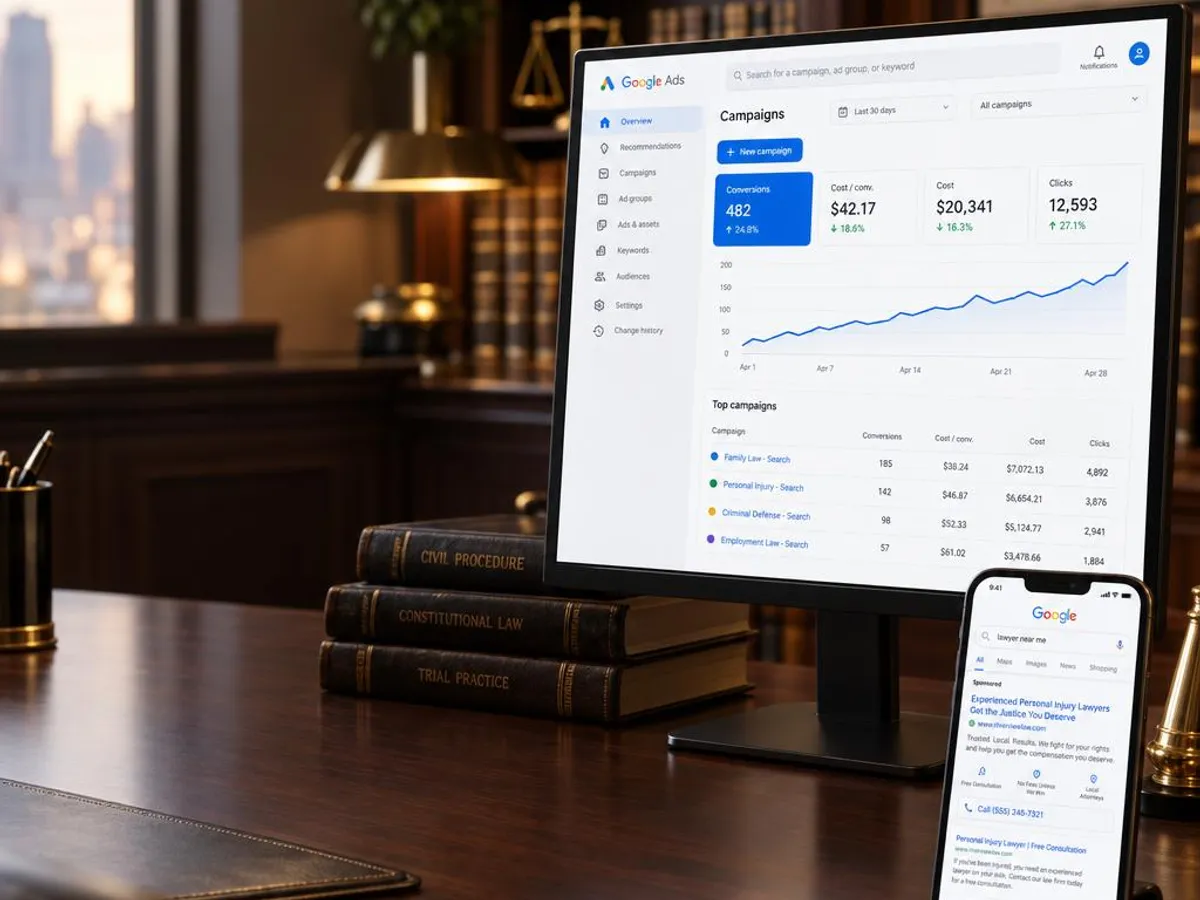
When Google Ads suits a law firm
Google Ads and organic search solve different problems for a law firm. SEO accumulates over time: a well-optimised site earns enquiries month after month without a per-click cost. Ads deliver results immediately, and stop when the budget stops. The question for most firms is not which one to use, but which one to prioritise, and when.
The argument for starting with Ads is timing. A firm that has recently launched, moved to a new location, or wants to grow a practice area it does not yet rank for cannot wait for organic authority to build. Ads can generate enquiries within days of going live, providing a return while SEO is still in progress. Many firms run both: a focused Ads campaign for the practice areas that need immediate volume, and an SEO programme that reduces dependence on paid traffic over time. The organic side is covered on the SEO for Lawyers page.
Where Ads has a structural advantage
Some searches suit paid results well: highly competitive terms where the organic results are crowded, searches where directories dominate the first page, and searches from people at a decision point rather than a research stage. This does not mean Ads is cheaper in those categories, only that a well-managed campaign can reach people ready to instruct at the moment they are searching.
Where SEO is more durable
For practice areas where clients read carefully before choosing a firm and where competition is manageable, organic search provides a more cost-effective position over the long term. Ads are a lever, not a foundation. The goal for most firms is to reduce reliance on paid traffic as organic rankings establish themselves.
Why waste control matters more in legal than in most industries
Legal is one of the most competitive categories in Google's auction. The firms, directories and lead generators bidding for the same searches are each working from a calculation about what a single client is worth. That competition drives click prices well above most other industries.
The consequence is that a wasted click costs more here than in almost any other context. A click from someone in the wrong state, a student looking up a legal definition, a person seeking free or pro bono advice, or a caller outside the firm's jurisdiction is not a potential client, but it costs the same as one from a person ready to instruct. Over a month, that waste adds up.
The cost of a thin campaign structure
A campaign that runs across all practice areas with broad match and no negative list gives Google full discretion over where the budget goes. In legal, where an irrelevant click costs as much as a qualified one, that approach tends to produce a campaign that looks active but does not convert. Tight structure and deliberate exclusions are the primary tools for keeping spend on the searches that matter.
Structuring campaigns by practice area and location
A single campaign covering every practice area, with a shared budget and broad targeting, is the most common mistake in a legal Ads account. It allows Google to distribute spend across whatever generates the most clicks, not the most valuable enquiries. Separating by practice area lets the firm allocate budget deliberately: more to the work it wants to grow, less to the rest.
One campaign per practice area
A family law campaign, a criminal law campaign, a personal injury campaign. Each has its own budget, its own keywords, its own ads and its own landing page. This structure makes the account straightforward to read: which practice area is generating enquiries, at what cost, and which is not justifying its spend. It also prevents a high-volume practice area from consuming the budget intended for a more valuable but lower-volume one.
Location targeting that matches where the firm can act
Google Ads allows targeting by suburb, postcode, city or region. A firm that practises in Sydney but targets all of New South Wales will generate calls from people it cannot serve, at the same cost as calls from people it can. Targeting should match the firm's actual catchment: the locations from which it can realistically take on work. Local SEO for law firms covers the organic side of location targeting.
Match types
Broad match gives Google wide latitude over which searches trigger an ad, and in legal that tends to produce waste until the account has solid conversion data. Phrase match and exact match give the firm control over which searches trigger its ads. Starting conservatively and refining as the campaign builds data is more reliable than starting broad and attempting to prune waste after it has occurred.
Negative keywords, out-of-scope searches and ad scheduling
Negative keywords prevent ads from appearing for searches the firm cannot or should not respond to. Building the negative list before launch, and extending it as the account accumulates data, is one of the most reliable ways to protect legal Ads spend from waste.
What to exclude
Common exclusion categories include: information-seeking searches (definitions, academic uses); no-cost searches (free legal advice, legal aid, pro bono); employment searches (law firm jobs, paralegal roles); student searches (law student, case study); and out-of-jurisdiction locations. The list is specific to each practice area. A criminal law campaign and a conveyancing campaign attract very different irrelevant searches and each needs its own list.
Ad scheduling for urgent matters
Legal enquiries do not arrive on a nine-to-five schedule. Someone charged and released on bail will search for a criminal lawyer at midnight. A person served with intervention papers over a weekend will look for help before the business week begins. For practice areas where matters arrive urgently, running ads after hours requires a mechanism in place to capture the enquiry: a direct mobile number, a clear response-time commitment on the landing page, or a brief message-taking service.
Scheduling for office-hours practice areas
Conveyancing, wills and most commercial work rarely require an immediate after-hours response. For these practice areas, restricting ad delivery to business hours and concentrating spend on the days with the strongest response rates is a straightforward way to reduce cost without sacrificing qualified enquiries. The account scheduling report shows which days and times generate calls; the budget can be focused there.
Calls as the main conversion: assets, landing pages and tracking
Most people who find a law firm through Google Ads will call, not fill in a form. Legal matters are personal and often urgent; most potential clients want to speak to someone before they commit to anything. The campaign should be built around calls as the primary outcome, not clicks to the website.
Call assets and call-only formats
Adding a phone number to a search ad through a call asset means the firm's number appears beneath the headline and a mobile searcher can call with one tap. Google also supports call-only ad formats, where a call button is the primary action and there is no link to a page. For practice areas where urgency drives the search, these formats can suit better than an ad that only links to a landing page.
Landing pages built per practice area
Sending a paid click to the firm's homepage wastes most of the investment. The person searched for a specific kind of help and arrived somewhere general. A practice-area landing page, focused on the matter the ad addresses and the location it targets, makes it faster for a potential client to confirm the firm can help and to take the next step. The page does not need to be long; it needs to be clear about what the firm does, where it practises, how to get in touch, and what happens after contact is made.
9:14Phone call · 6m 42sProperty settlementOrganicQualified
13:02Web formParenting arrangementsMapsQualified
10:37Phone call · 1m 05sOut of jurisdictionAdsNot a fit
16:48Phone call · 11m 20sDivorce applicationOrganicQualified
Call tracking and the enquiry log
A paid click that cannot be traced back to an enquiry is invisible. Call tracking assigns a number specific to ad traffic, so calls from the campaign are logged separately from organic and direct calls. The enquiry log records each call by source, practice area and whether it was a qualified matter. Click-through rate and cost per click are intermediate metrics; the measure that matters is cost per qualified enquiry and, over time, cost per instructed matter. The law firm marketing page covers how we track across paid and organic channels.
Ad copy within the conduct rules
Ad copy for a law firm operates inside a narrower space than copy for most other advertisers. The conduct rules that apply to Australian solicitors require that advertising not be false, misleading or deceptive, including about the lawyer's expertise, and the detail varies by state. These rules apply to Google Ads as they apply to any other advertising the firm places.
Outcome claims
Headlines that imply a guaranteed result, such as 'we win' or 'your case, resolved', risk misleading the reader about an outcome no firm controls. Claims that could create an unrealistic expectation, even without an explicit guarantee, are the kind of language that generates a compliance complaint. The constraint reflects the reality that legal outcomes depend on facts, courts and circumstances no firm controls.
Specialist titles
The word 'specialist' carries a specific meaning in legal advertising. State law societies run specialist accreditation schemes, and describing a lawyer as a specialist without that accreditation risks a false impression of specialist expertise, which the conduct rules prohibit. Firms without accreditation use descriptions like 'experienced', 'practising in' or 'focused on' rather than 'specialist': accurate, defensible and less likely to draw a conduct inquiry.
Every ad headline, description and extension is drafted to our brief and reviewed by a nominated person at the firm, typically a partner or principal, before it goes live. We flag any claim that sits close to the conduct line and offer compliant alternatives. The firm approves the final copy. We do not publish ad copy on behalf of a firm without that sign-off, and we keep a record of each approval. For Queensland firms with personal injury campaigns, we review copy specifically against the PIPA restrictions before the campaign launches.
Personal injury advertising in Queensland
Queensland has state-specific restrictions on personal injury advertising under the Personal Injuries Proceedings Act 2002 (Qld) (PIPA), sections 63 to 69. Ads for personal injury services are restricted in content to the name and contact details of the firm and the areas of practice it handles. Conditional-fee statements, such as no-win-no-fee, are permitted only on the firm's own website, not in ads placed on other platforms or advertising surfaces.
In February 2026, the Queensland Civil and Administrative Tribunal fined a Queensland lawyer $30,000 for advertising that breached these rules, including billboard and online statements featuring "No Win, No Fee" language. The Tribunal noted the conduct was prevalent in personal injury practice, which suggests the restrictions are not well understood. Queensland firms running personal injury ads should check their copy against the Queensland Law Society's guidance before publishing. Firms in other states should check whether any state-specific advertising restrictions apply to their practice area.
Budgets, bidding and reporting in plain English
A legal Ads budget should be set from the value of the matters the firm wants to attract, not from what seems affordable. The campaigns that produce the most durable results are those built carefully on a modest budget and expanded as the account accumulates data about what converts, rather than launched at scale before the structure is sound.
Bidding
Automated bidding works by optimising for a conversion signal. For a new legal account, conversion data is thin and the algorithm has little to work from. Starting with manual cost-per-click bidding gives the firm more control while the account builds history. As data grows, a target cost-per-acquisition strategy becomes viable.
Reporting
Monthly reporting should answer the question a partner or practice manager actually cares about: how many qualified enquiries did the campaign generate, in which practice areas, and at what cost? Click-through rates and quality scores are useful diagnostics for the account manager but should sit behind a plain-English summary of calls, qualified enquiries and spend, with the reasoning behind any budget adjustments. For an overview of how search marketing fits into a firm's growth plan, the marketing for law firms page has more context.