
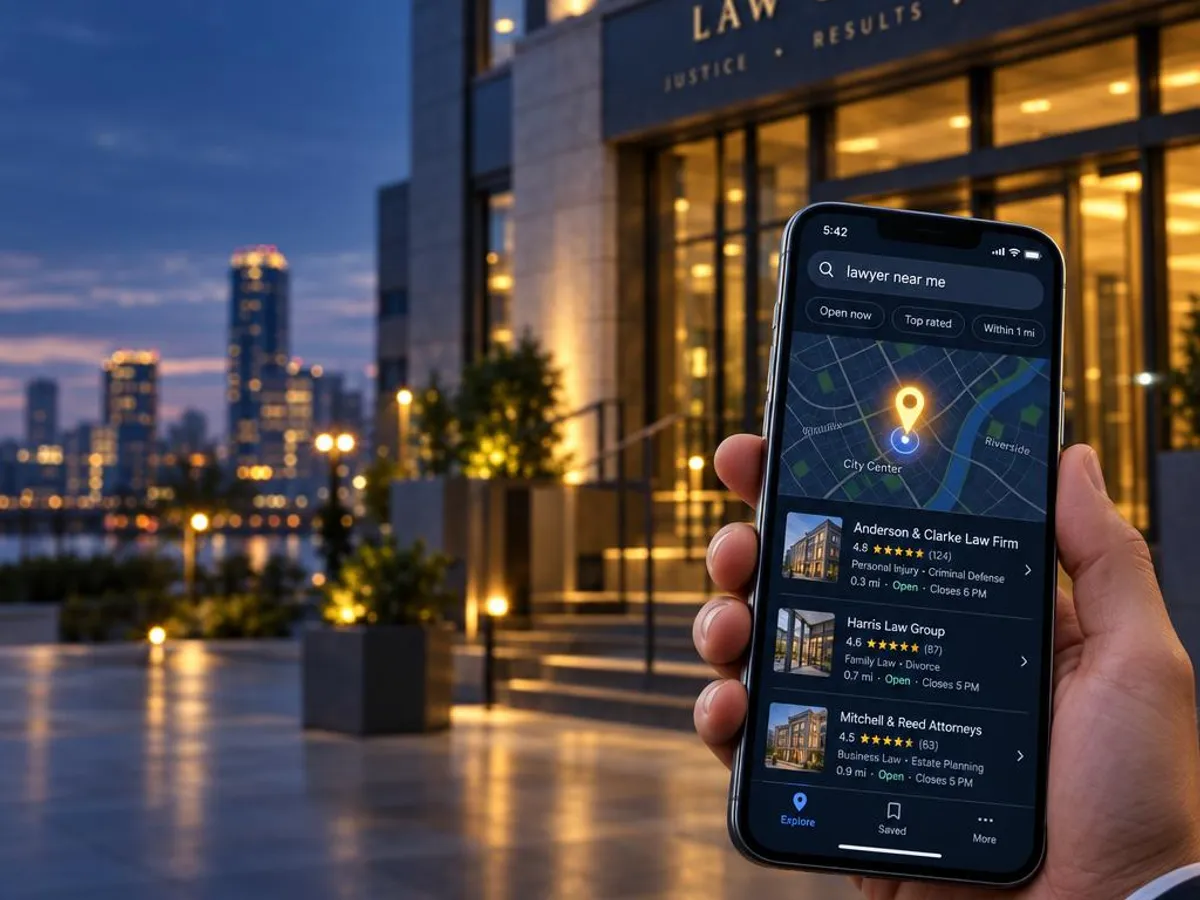
The Maps pack: what it is and why it matters
When someone searches 'family lawyer Parramatta' or 'family lawyer near me' on a phone, the first results they see are not websites. They are a map with three business cards underneath it. This cluster is the Maps pack, and for most local legal queries it appears above the ten organic results that typical SEO focuses on.
Google has documented that its local ranking algorithm uses three signals: relevance, which measures how closely a business profile matches the search; distance, which reflects proximity to the searcher; and prominence, which accounts for how well-known the business is online. These three factors combine to decide which three firms appear for each query.
The practical consequence is significant. A firm can rank well in the organic results below the map and still receive fewer enquiries than a competitor holding a Maps pack position. For urgent searches, particularly those made on phones in the hours after something goes wrong, the three cards in the Maps pack are often all a person looks at before calling.
Local SEO is a distinct undertaking from SEO for lawyers more broadly. It centres on the specific signals that move a firm into the Maps pack: the Google Business Profile, suburb content, directory listings and reviews.
Google Business Profile: the inputs that drive the pack
The Google Business Profile is the primary input for Maps rankings. Google uses what a firm provides in the profile, alongside signals from its website and from third-party sources, to assess how relevant and prominent the business is for each local search. A profile left at its defaults sends a signal of inattention. A well-maintained one is a competitive asset.
Categories and services
Every profile has a primary category and up to nine secondary categories. For a law firm, the primary is typically 'Law Firm', with secondary categories for each practice area the firm wants to appear for. The services section is separate and goes further: listing each practice area by name, and optionally a brief description of each, helps Google match the profile to specific legal searches. A firm that does not list its practice areas in the services section is leaving relevance signals unused.
Hours, photos and posts
Hours must be accurate, including public holiday and special hours. An out-of-date or missing hours listing leads to Google showing incorrect times or marking the business as temporarily closed, which reduces trust and can suppress the profile in relevant results. Photos of the office exterior, reception and meeting rooms give prospective clients a sense of the environment. Regular posts show the profile is looked after.
Accuracy
The firm name used in the profile must match exactly how the firm is known in practice and on its website, and the address and phone number must match everywhere else the firm is listed. Inconsistent details make it harder for Google to be confident which information is correct, which is a problem for a signal that depends on trust.
“A complete, accurate Google Business Profile is the foundation of local visibility. Without it, suburb pages and directory listings have nothing solid to anchor to.”
Suburb pages: connecting the firm to the places it serves
Most clients choose a lawyer near where they live or work. A family law firm based in Parramatta will receive searches not just for Parramatta but for surrounding suburbs: Westmead, Merrylands, Granville, Penrith. Suburb-level landing pages that connect the firm to the areas it genuinely serves are one of the mechanisms that help it appear in those searches.
Legitimate suburb pages and the doorway-page problem
There is a distinction between a page that genuinely connects a firm to a place and what Google calls a doorway page: a near-duplicate page where only the suburb name changes. A page that opens with 'Family Lawyer Merrylands, serving clients across Western Sydney with expertise in property settlements and parenting arrangements' and then provides real, useful content is a legitimate location page. A page that is a copy of the Parramatta page with 'Merrylands' substituted throughout is a doorway page, and Google has specifically stated it treats doorway pages as spam.
The practical approach is to create suburb pages for the locations where the firm genuinely has clients or reasonable proximity, and to write each one with content specific to that suburb or the clients likely to come from it. Not every suburb within thirty kilometres warrants its own page. A small set of well-written, geographically relevant pages outperforms a large set of thin, near-identical ones.
Service-area configuration
Some firms practise in ways that do not fit the single-office, single-location model. Family lawyers who attend court across multiple jurisdictions, or immigration practitioners who see clients statewide, may serve areas well beyond their office address. Google Business Profile allows a firm to set service areas, signalling to Google the geographic scope of its practice without implying a physical office in each suburb. For firms in this situation, service-area configuration is the appropriate tool rather than creating suburb pages for locations without a genuine presence.
Citations: consistent details across the directories that matter
A citation is any mention of a firm's name, address and phone number on an external website. Google uses the pattern of citations across directories, association listings and legal portals to verify the accuracy of the information in a firm's Business Profile and to assess its prominence in the local area. Prominence is one of the three documented local ranking factors, and citations are a direct input to it.
For law firms, the most relevant citations come from legal directories and professional associations first: the firm's state law society listing, find-a-lawyer directories, and legal portals built around practice. General business directories, local chamber of commerce listings and reputable local directories follow. The volume of citations matters less than their consistency. A firm listed as 'Harbour & Finch Lawyers' in one place and 'Harbour and Finch' in another sends a conflicting signal to Google about which details are authoritative.
What to check across every listing
Every directory listing should carry the firm's full name as used in practice, its current address including floor and suite numbers where applicable, and the phone number that appears on the website and in the Business Profile. Practice areas listed in the directory should reflect what the firm currently offers. Old addresses and phone numbers from previous offices frequently remain in directories years after a move, and they need to be corrected rather than ignored.
Reviews: prominence, conduct rules and a compliant approach
Reviews on a Google Business Profile contribute to the prominence signal in local rankings and appear visibly in the Maps pack card, influencing whether a prospective client chooses to click or call. A firm with a consistent record of recent, genuine reviews usually holds an advantage in Maps over a competitor whose profile is silent.
Reviews a firm asks for, or shares in its own marketing, can be treated as testimonials, and testimonials fall within the advertising rules that apply to Australian lawyers. Those rules vary by state and territory, but the general principle across all jurisdictions is that advertising must not be false, misleading or deceptive. Some states have additional restrictions on how client testimonials may be used or how client identity may appear in marketing materials. Before setting up any review-gathering process, a firm should confirm the approach with its state law society or legal services regulator.
A practical approach that reduces risk
A compliant approach to gathering reviews asks every client at matter closure, not only the ones likely to respond positively. It does not coach or incentivise the content of a review. It provides a direct link to the Google Business Profile review form so the process is frictionless, and it keeps records of who was asked and when. Responding to reviews, including negative ones, with a measured and professional reply is visible to every future prospective client who reads the profile.
We do not publish any review-gathering process without the firm's approval of the approach and the copy. Where conduct rules may affect the method, we flag the issue and recommend the firm confirm the approach with its state law society before proceeding. We do not ask for reviews on a firm's behalf and we do not draft review text. Our role is to make the process straightforward and to ensure the mechanics, such as a link in a matter-closure email, are accurate and consistent. The free audit reviews your Business Profile, reviews included, as part of the initial report.
Negative reviews are a separate challenge. A professional, measured response to a negative review is visible to every future reader. Responding promptly, acknowledging the concern without conceding a specific legal position, and keeping the response brief signals competence and care. An ignored negative review signals neither.
Multi-office firms: one profile per location
A firm operating from two or more offices needs a separate Google Business Profile for each location. A single profile with multiple addresses listed in the description does not serve multiple offices correctly, and trying to represent several locations through one profile leaves most of them without any Maps presence for searches near those addresses.
Each profile operates independently. The primary category, services, hours and photos need to be set for each location individually. The phone number should reach the office at that address rather than a central switchboard, so a caller who found the firm on Maps speaks to someone who knows that location.
Prioritising across offices
For firms with multiple locations, it is rarely practical to optimise every office to the same depth at once. The typical starting point is the office in the most competitive local market, or the one where the firm most wants to grow enquiry. Once that profile is performing well, the same process applies to the next. A firm's law firm marketing strategy should account for which locations matter most before deciding where to concentrate local SEO effort first.
“Each office has its own local market and its own competition. Treating multiple locations as one produces one profile competing poorly across all of them.”
Tracking calls and direction requests from Maps
A Maps pack position is only useful if it produces enquiries. Google Business Profile Performance, the reporting section inside the profile, shows how many people called the firm from the profile, how many requested directions, and how many clicked through to the website. These numbers are the most direct measure of whether a local SEO programme is producing results, and they are separated from organic website traffic, which makes attribution cleaner.
Call tracking numbers add a layer of precision that the profile dashboard alone cannot provide. A dedicated local number, forwarded to the firm, records when a call came in, how long it lasted, and whether it was answered. Combined with source data from the Business Profile, this gives a month-by-month view of enquiry coming directly from Maps, separate from the website. It is the same call-tracking approach described in Google Ads for law firms, applied to Maps.
Direction requests are worth monitoring alongside calls. When someone requests directions from Google Maps, it is a strong indicator of intent. Tracking this metric over time shows whether the profile is reaching people who are actively planning to visit the office, distinct from calls and form submissions.
- i.How many calls came from our Google Business Profile this month?Check GBP Performance under 'Calls'. Compare the number to website enquiries to understand what share of local enquiry comes from Maps.
- ii.Does our firm appear in the Maps pack for our main practice areas and nearby suburbs?Search from a phone in the suburb, signed out of your Google account, to see what a prospective client sees.
- iii.Do our name, address and phone number match exactly across our website, our profile and the main directories?A citation audit finds inconsistencies faster than a manual check, and they can hold back Maps visibility in ways that are hard to trace without one.
- iv.Are our hours and services sections current?Check for outdated hours after any office changes, and confirm that all current practice areas are listed in the services section.